


UbD Template: Empowering Students Through E-Portfolios
Crosby High School | Grades 11–12
Focus: Student Digital E-Portfolios for College, Career, and Personal Readiness
Stage 1 - Desired Results
-
Support students in developing digital literacy and reflective thinking skills essential for post-secondary success.
-
Align e-portfolio implementation with Crosby ISD’s Portrait of a Graduate, which emphasizes creativity, communication, critical thinking, and ownership of learning.
-
Align with TEKS for College and Career Readiness, English Language Arts, and Technology Applications (Texas Education Agency, 2022).
-
Reflect the ISTE Standards for Students (ISTE, 2016), particularly the roles of “Empowered Learner” and “Knowledge Constructor.”
Stage 2 - Evidence
Students will build and publish a final e-portfolio that includes:
-
A personal introduction and vision statement
-
3–5 artifacts with detailed reflections
-
A career or college readiness plan (resume, goals, action steps)
-
A final presentation or defense to a panel of teachers, peers, or community members
Stage 3 - Learning Plan

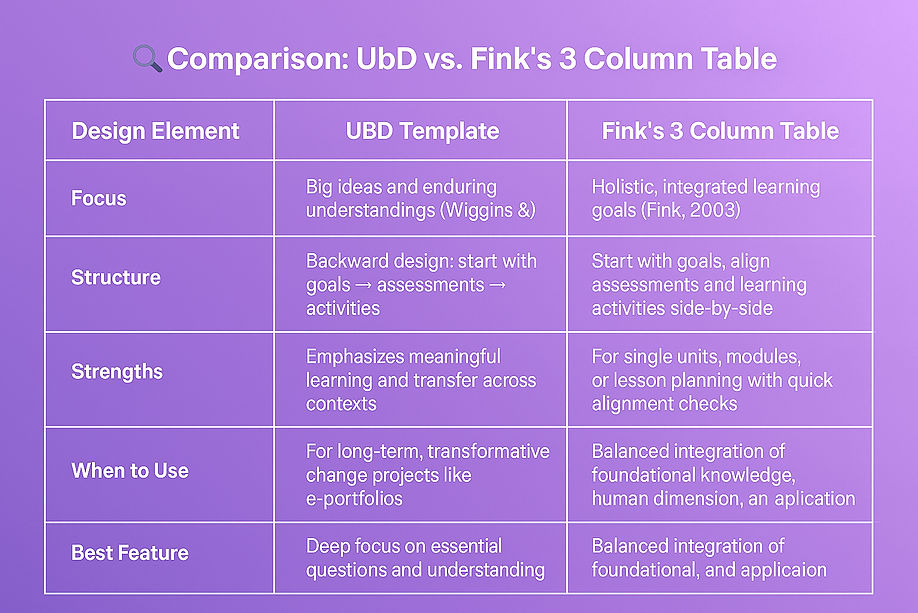
Reflection: Applying UbD & Fink to My Innovation Plan
Both UbD and Fink’s models have significantly influenced how I think about planning for impact.
Fink’s 3 Column Table was incredibly useful in the early stages of my e-portfolio planning. It helped me clearly identify the foundational knowledge students needed, the real-world application of digital portfolios, and the emotional/reflective components that give portfolios personal meaning. His holistic view—especially the “Human Dimension”—reminded me that students aren’t just learners; they’re future professionals, storytellers, and creators (Fink, 2003).
But as I moved into implementation, the UbD Template became the stronger framework. Its backward design approach helped ensure every activity was purposefully aligned with the end goals of empowerment and reflection. The essential questions drove deeper thinking, and the staged process mirrored the real work of cultural change at a school level. Wiggins and McTighe (2005) emphasized that when students understand why they’re learning and how it connects to their lives, they engage more authentically. That’s exactly the mindset I want to build at Crosby.
Using both frameworks has helped me grow as a leader and designer. I now see how powerful alignment is—not just between goals and lessons—but across systems, people, and values. These tools will continue to shape my leadership as I scale e-portfolios school-wide, train teachers, and ultimately create a culture where reflection and ownership are the norm.
References
Boaler, J. (2016). Mathematical mindsets: Unleashing students' potential through creative math, inspiring messages, and innovative teaching. Jossey-Bass.
Fink, L. D. (2003). Creating significant learning experiences: An integrated approach to designing college courses. Jossey-Bass.
International Society for Technology in Education. (2016). ISTE standards for students. [https://www.iste.org/standards/iste-standards-for-students](https://www.iste.org/standards/iste-standards-for-students)
Texas Education Agency (2022). Texas Essential Knowledge and Skills (TEKS). [https://tea.texas.gov/academics/curriculum-standards/teks/texas-essential-knowledge-and-skills](https://tea.texas.gov/academics/curriculum-standards/teks/texas-essential-knowledge-and-skills)
Wiggins, G., & McTighe, J. (2005). Understanding by design (Expanded 2nd ed.). ASCD.